Electrosensitivity (EHS)
Symptoms, Causes and Solutions
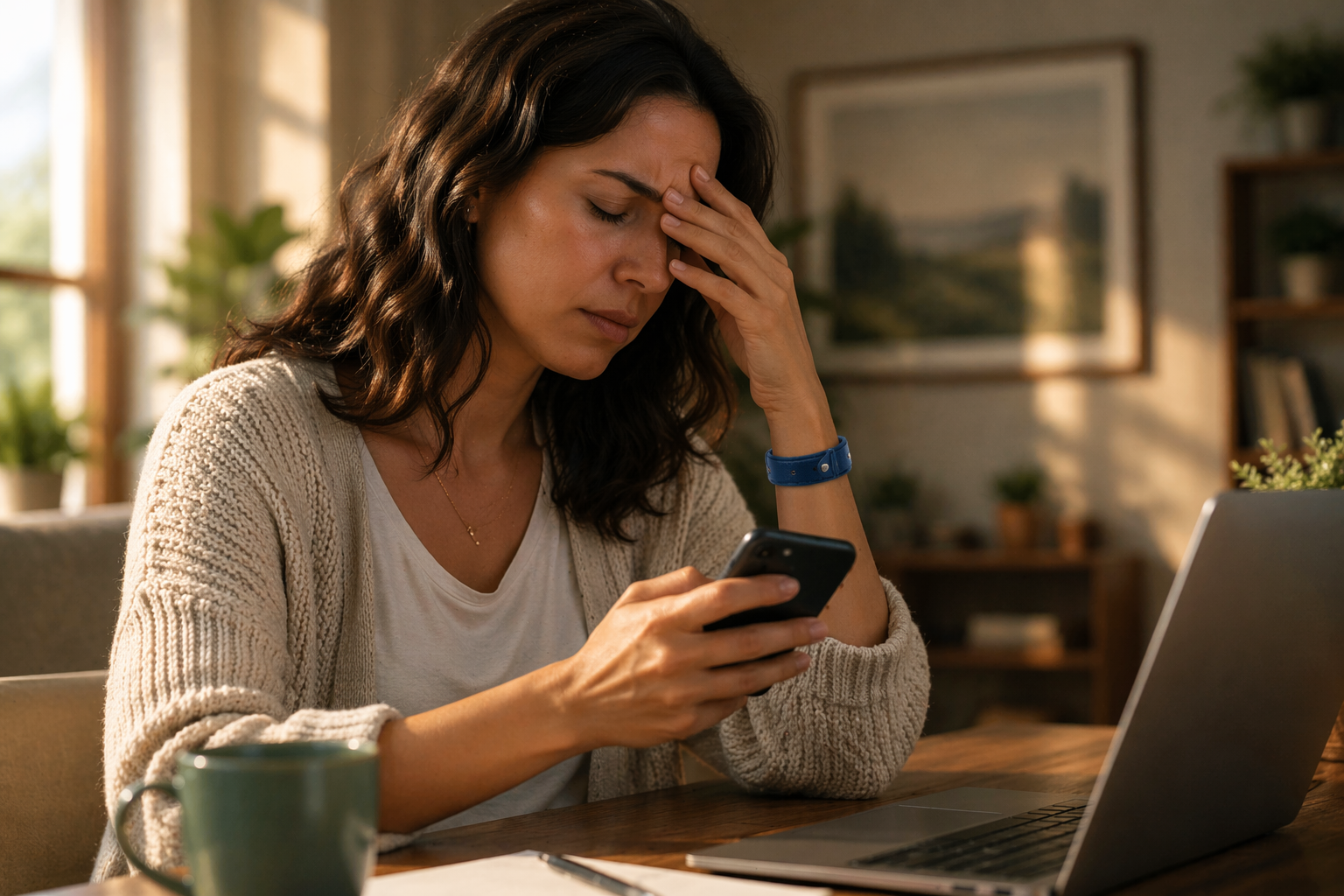
Headaches, chronic fatigue, insomnia… These symptoms deserve to be understood, not ignored. Understand EHS to address it — with factual answers sourced from the best authorities.
Electrohypersensitivity (EHS), sometimes called "idiopathic environmental intolerance attributed to electromagnetic fields" (IEI-EMF), refers to a set of physical and cognitive symptoms that affected individuals attribute to their exposure to electromagnetic fields — mobile phones, WiFi, cell towers, high-voltage lines.
Estimated at between 3% and 8% of the French population by ANSES (2021), or 2 to 5 million people, EHS remains one of the most controversial and misunderstood conditions in our healthcare system.
- Why EHS is a medical reality, even if its causality remains debated
- The most frequently reported symptoms and their frequency
- What science says about the biological mechanisms involved
- Concrete solutions to improve your daily life today
- Your legal rights in France and legal precedents
Section 1 What is Electrohypersensitivity? [Definition]
The WHO defines EHS as a phenomenon where individuals experience adverse health effects when using or being near devices emitting electric, magnetic, and electromagnetic fields. This definition recognizes the reality of the symptoms while stressing that the causal link with waves is not yet definitively scientifically established.
Contrary to popular belief, EHS is not limited to "hypochondriac or technophobic" individuals. Many EHS sufferers were heavy technology users before their symptoms appeared. Symptoms are biologically measurable and often occur after sudden overexposure.
📊 Prevalence and Epidemiological Data
| Indicator | Data | Source |
|---|---|---|
| Estimated prevalence in France | 3% to 8% of the population | ANSES 2021 |
| Or in number of people | 2 to 5 million French people | ANSES 2021 |
| Prevalence in Sweden | 3.2% | Swedish national study |
| Prevalence in the UK | 4% | UK Biobank study |
| Average age of onset | 40–55 years | Meta-analyses |
| Severe forms (real disability) | >10% of EHS individuals | Expert estimates |
Section 2 EHS Symptoms [Full Identification]
EHS symptoms are varied, often multiple in the same person, and fluctuate in intensity depending on the level and duration of exposure. The most distinctive characteristic is the temporal correlation: symptoms appear or worsen during exposure to electromagnetic sources and improve in low-exposure environments.
📈 Frequency of Report by EHS Individuals
🗂️ Symptoms by Category
🧠 Neurological
Headaches, migraines, dizziness, tinnitus, memory difficulties, concentration problems, unexplained urges to laugh or cry
😴 Sleep
Insomnia, frequent nighttime awakenings, non-restorative sleep, agitated dreams, difficulty falling asleep even without stimuli
⚡ Energy & Fatigue
Unexplained chronic fatigue, disproportionate exhaustion after exertion, increased need for sleep, daily vitality decline
❤️ Cardiovascular
Palpitations, accelerated heart rate, blood pressure variations, feeling of chest pressure near sources
🌡️ Cutaneous
Tingling, burning or prickling skin, localized redness near exposure areas, unexplained hot flashes
🔬 Digestive
Intestinal problems, nausea, abdominal pain, general feeling of malaise when exposed to connected devices
Section 3 Causes of EHS: What Science Says [Analysis]
Several biological mechanisms are being studied to explain why some people develop increased sensitivity to electromagnetic fields. These mechanisms are biologically measurable, regardless of conscious perception.
| Mechanism | Explanation | Level of evidence |
|---|---|---|
| Cellular oxidative stress | Increased production of free radicals in exposed cells. Studies show a reduction in superoxide dismutase (SOD) in EHS individuals. | 🟠 Moderate |
| BHE permeability | Work by Prof. Salford (Sweden) shows an increase in blood-brain barrier permeability after radiofrequency exposure. | 🟡 Limited |
| Melatonin disruption | Melatonin is the sleep-regulating hormone and a powerful antioxidant. Studies show a reduction in its secretion by the pineal gland in the presence of electromagnetic fields. | 🟠 Moderate |
| Mast cell activation | Mast cells are immune cells in the brain. Studies (Theoharides 2012) show that waves can activate these mast cells, triggering an inflammatory response in the brain. | 🟡 Limited |
| CNS sensitization | A mechanism with no analogue in environmental literature. After initial exposure, the CNS becomes progressively hypersensitive to increasingly weaker future exposures. | 🟡 Preliminary |
Section 4 Misconceptions about EHS [True / False]
EHS symptoms are documented by measurable biological mechanisms (oxidative stress, mast cells, melatonin). It is not just simple nocebo or psychosomatic disorders. One should not confuse absence of proven causality with absence of real effect.
A majority of EHS sufferers report significant improvement in their symptoms after reducing exposure. Documented case studies show measurable improvements after moving or adapting the workplace with CBT adapted for EHS.
Many EHS sufferers describe a clear trigger — installation of a cell tower, switching to a 5G smartphone, moving into an apartment with a WiFi box. This progressive sensitization mechanism is consistent with central nervous system sensitization theories.
The Defender of Rights has recognized the need for professional accommodations for EHS individuals. Job accommodations (isolated office, wired workstation, telecommuting) have been granted, particularly in the public sector, reducing symptoms by 70% in some cases.
Section 5 Solutions: How to Live Better with EHS [Practical Guide]
There is no specific medical treatment for EHS. However, reducing exposure to electromagnetic fields remains the most effective approach to improving the quality of life for affected individuals.
🏠 1. Clean Up Your Immediate Environment
🛏️ Create a "Sanctuary" Bedroom
Night is the best opportunity to reduce exposure — your body recovers better without waves.
- Turn off WiFi at night via a programmable outlet (~€15)
- Remove all connected devices from the bedroom (tablets, phones, speakers)
- Put your phone in airplane mode before sleeping
- Always place the charger at least 1.5m from the bed
- Opt for an analog alarm clock — the secret weapon of EHS individuals
🔌 Go Wired as Much as Possible
Every wireless connection is a constant source of waves — every cable is a victory.
- Ethernet cable for desktop and laptop computers
- Wired landline phone instead of wireless DECT
- Wired mouse and keyboard
- Disable WiFi and Bluetooth on the computer when wired
📱 Tame Your Smartphone
- Airplane mode at night in rest areas
- Never make calls without a wired hands-free kit (95% reduction in brain exposure)
- Keep the phone as far as possible in your pocket — or place it in a bag
- Prioritize SMS over voice calls when the network is weak (the phone then emits at maximum power)
- Update your phone — Android/iOS updates often improve emission power management
🌿 3. Medical and Natural Support
- Consultation with a doctor trained in EHS: specialized practitioners exist (Medinat network, environmental medicine)
- Oxidative assessment: measurement of oxidative stress via specific blood tests (8-OHdG, isoprostanes)
- Natural antioxidants: vitamin C, vitamin E, selenium, coenzyme Q10 — on medical advice
- Melatonin: as a supplement on medical advice, to restore disturbed sleep cycle
- Support therapies: sophrology, cardiac coherence, CBT adapted for EHS-related anxiety
- Gradual avoidance: a gradual reduction in exposure often yields better results than an abrupt cut-off
Section 6 Recognition and Legal Framework in France [Rights]
| Body | Official position |
|---|---|
| WHO | Recognizes symptoms as real, does not recognize demonstrated electromagnetic causality |
| ANSES (France) | Recognizes EHS as a condition warranting medical attention; recommends precaution |
| Défenseur des droits (France) | Recognizes the need for professional accommodations for EHS individuals |
| Sweden | Recognizes EHS as a functional disability since the 2000s |
| TGI France (2015) | Granted a disability pension to an EHS individual (Marine Richard case) |
| Loi Abeille (France, 2015) | Provides protection measures for electrosensitive individuals (white zones, exposure reduction) |
In 2015, a French court for the first time granted a disability pension to an electrosensitive woman. The decision marked a turning point in the legal recognition of EHS in France and paved the way for other appeals.
Section 7 Conclusion: Neither Denial, Nor Catastrophism
We interact daily with electrosensitive people, with over 10 years of experience:
- EHS is a reality of suffering that deserves to be taken seriously
- Reducing exposure is the best available action today
- Medical support significantly adapts quality of life
- Our patented devices provide complementary protection, measured and tested by NEXIO.
- You are not alone: associations, doctors, and solutions exist.
FAQ — Frequently Asked Questions about EHS
How do I know if I am electro-sensitive?
Is EHS recognized as a disease in France?
Can electromagnetic hypersensitivity be cured?
My doctor doesn't believe in EHS. What should I do?
Are Wave Protect anti-wave devices effective for EHS?
Resources for Further Reading
🛡️ Our Devices Adapted for EHS Individuals
Patented technology, tested by the independent NEXIO laboratory. Thousands of electro-sensitive individuals have trusted us for over 10 years. Made in France, guaranteed 60-day satisfaction or your money back.
Wave Protect France — 5 ter rue de la Gaucherie, 18100 Vierzon — contact@wave-protect.fr
This article is for informational and educational purposes. It is not a substitute for medical advice.
Partager:
Electromagnetic Waves: Complete 2026 Guide to Understanding and Protection